Inverter Backup Calculator: How Long Will Your Battery Last? (2026)
Short answer: Use the inverter backup calculator below: choose your battery and tick what you run in a power cut. The formula is battery Ah x battery volts x efficiency, divided by the load in watts. A 150Ah, 12V battery running two fans, three tube lights and the WiFi router (290 watts) lasts about 6 hours on paper and nearer 5 hours once losses are counted.
Shop at Quality Computer
Inverters and inverter batteries View all →
Inverter backup calculator
Set your battery, then add the things you keep on when the power goes. The wattages are typical figures; change any of them to match the label on your own appliance.
Battery
What you run in a power cut
| Appliance | Watts each | How many |
|---|
Estimate only: hours = Ah x 12 x number of batteries x condition / load in watts. A healthy, fully charged battery is assumed.
The result is an estimate for a healthy, fully charged battery. An old battery, a hot room or a heavy load will give less. The sections below explain the maths and what changes it.
How to calculate inverter battery backup time
Battery makers publish the same simple formula. Genus gives it as backup time in hours = battery capacity (Ah) x input voltage (V) x efficiency / total load (watts). Leave the efficiency out for a moment and you get the paper figure.
Take the example Livguard works through: a 150Ah, 12V battery running two fans, three tube lights and a WiFi router.
- 2 fans at 75 watts = 150 watts
- 3 tube lights at 40 watts = 120 watts
- 1 WiFi router at 20 watts = 20 watts
- Total load = 290 watts
Backup time = 150 x 12 / 290 = about 6.2 hours.
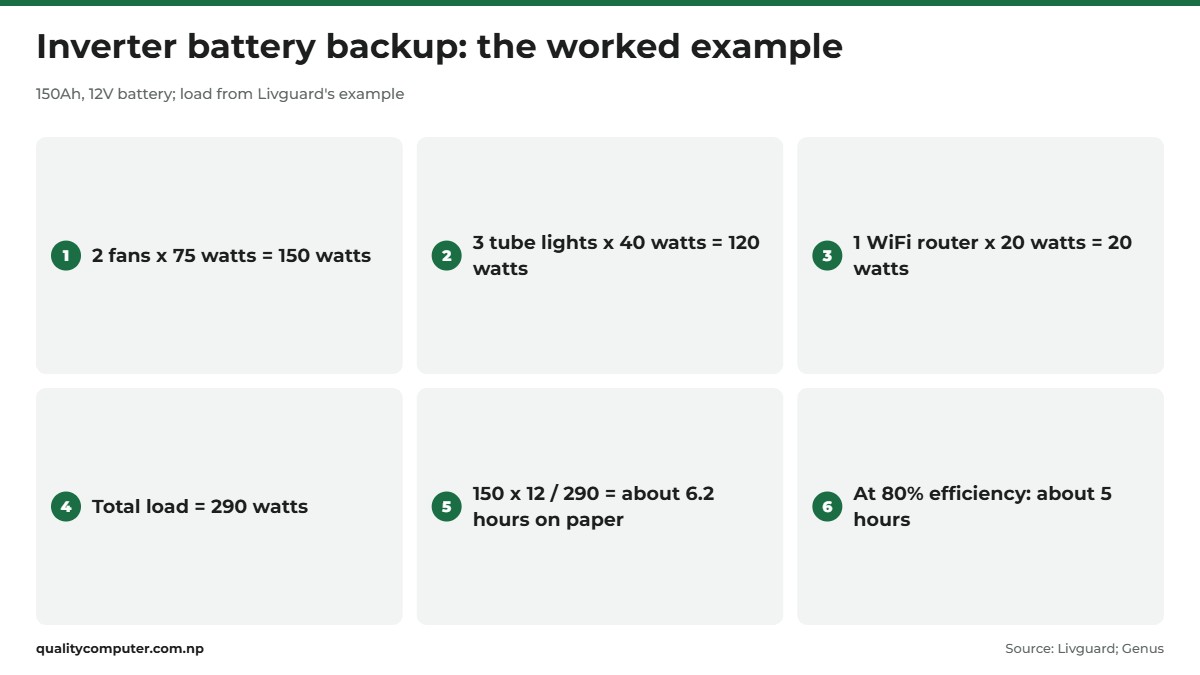
That is the paper figure. An inverter loses some energy turning the battery's DC into AC for your sockets, so the makers multiply by an efficiency factor. Livguard says most inverters work at 90 to 95% efficiency and uses 0.95, which turns 6.2 hours into about 5.9. Genus uses 95% as well and reaches the same 5.9 hours.
Our calculator uses 80% by default, because batteries in real homes are rarely new or fully charged. On that basis the same load runs for about 5 hours. You can switch it to 90% for a new battery.
Backup time of 100Ah, 150Ah and 200Ah batteries
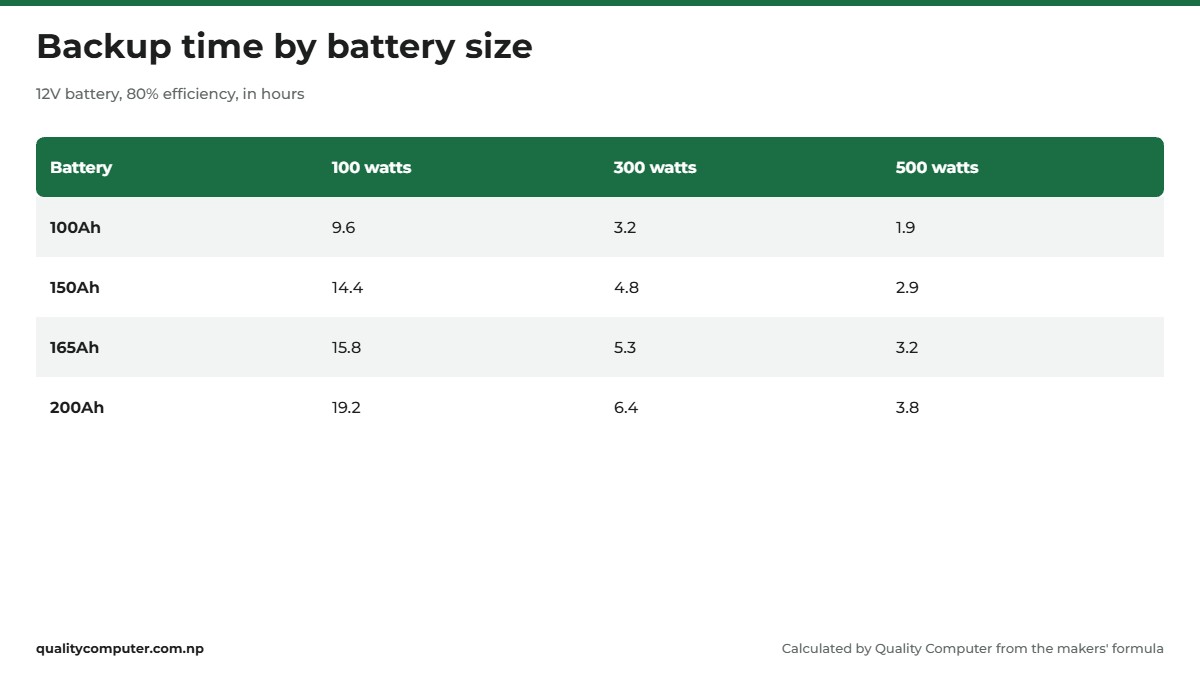
Here is what the formula gives for common 12V battery sizes at three loads, using 80% efficiency. All figures are in hours and are our own calculations from the formula above.
| Battery (12V) | 100 watts | 300 watts | 500 watts |
|---|---|---|---|
| 100Ah | 9.6 | 3.2 | 1.9 |
| 150Ah | 14.4 | 4.8 | 2.9 |
| 165Ah | 15.8 | 5.3 | 3.2 |
| 200Ah | 19.2 | 6.4 | 3.8 |
What do those loads look like? About 100 watts is a few LED bulbs, the WiFi router and a phone charger. About 300 watts adds two ceiling fans and a TV. About 500 watts adds a desktop computer or a fridge.
Two batteries joined for a 24V inverter store twice the energy, so double the hours for the same load.
Why real backup is shorter than the formula
If your inverter gives up sooner than the sum says, one of these is usually why.
- Battery age. A battery holds less every year. A four-year-old 150Ah battery does not behave like a new one.
- Not fully charged. After a long cut, the battery needs hours of mains power to fill again. Back-to-back cuts start from a part-full battery.
- Heavy loads drain faster than the sum suggests. Lead-acid batteries deliver less of their rated capacity when discharged quickly (Victron explains why), so a 500 watt load does worse than the table.
- Motors and compressors. A fridge or water pump draws more power when its motor starts than it does once running. That can trip a small inverter even when the running load looks fine.
- Low water and dirty terminals on tubular batteries. Low water cuts capacity and corroded or loose connections waste power. Both are easy to fix.

Running a battery flat every time also puts more strain on it and shortens its life. If you regularly need more hours than your battery gives, a larger battery is cheaper in the long run than replacing a small one early.
Which battery and inverter size you need
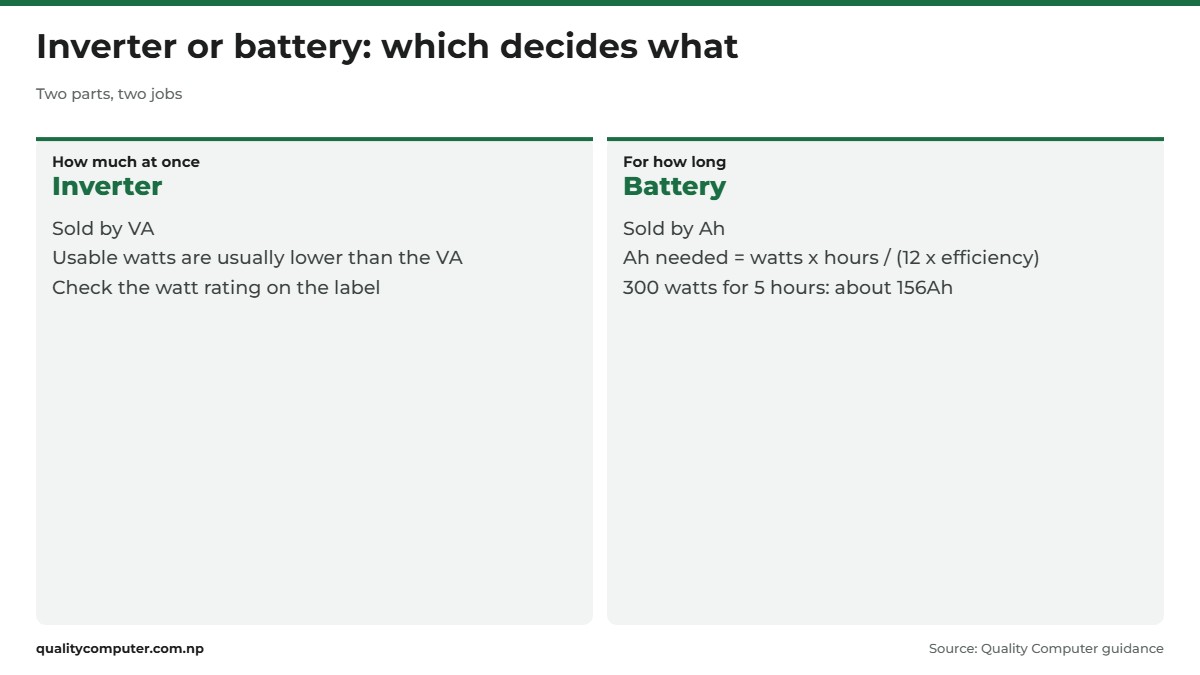
The two parts do different jobs. The inverter decides how much you can run at once. The battery decides for how long.
Inverter size. Add up the watts of everything you want on together and leave headroom. Inverters are sold by VA, and the usable watts are usually lower than the VA number, so check the watt rating on the label or the product page instead of assuming. Our inverter buying guide has worked examples, and Luminous vs Su-Kam compares the two brands most homes choose between.
Battery size. Turn the formula round: Ah needed = load in watts x hours wanted / (12 x efficiency). For 300 watts for 5 hours at 80%, that is 300 x 5 / 9.6 = about 156Ah, so a 150Ah or 165Ah battery.
Tall tubular batteries are the usual choice for home inverters because they handle long, repeated discharges. Sealed (SMF) batteries need no topping up and suit offices and smaller loads. Our inverter battery guide explains the types and warranties.
If all you need is internet during a cut, you don't need an inverter at all. A router UPS keeps the WiFi on for hours, and a computer UPS gives a desktop the few minutes it needs to save and shut down.
How to get more backup from the same battery
- Cut the load first. Halving the watts doubles the hours. Swapping three 40 watt tube lights for LED bulbs saves more backup than any accessory.
- Keep heavy appliances off the inverter line. Irons, heaters, kettles and the geyser should not be on it at all.
- Top up tubular batteries with distilled water, never tap water, when the level indicators drop, and keep the terminals clean and tight.
- Give the battery air. Heat shortens battery life, so don't box it in.
- Use what the sun gives. If cuts are long where you live, a solar panel can recharge the battery in the daytime.

When the calculator shows far more hours than you actually get from a full charge, and the load hasn't changed, the battery is near the end of its life. Have it tested before you buy a bigger inverter.

Quick verdict
- Backup hours = battery Ah x 12 x efficiency / load in watts.
- A 150Ah battery runs about 300 watts for roughly 5 hours; 200Ah, about 6.4 hours.
- The inverter size sets how much you can run at once; the battery sets how long.
- Cutting the load is the cheapest way to get more hours.
- For internet only, a router UPS does the job without an inverter.
Inverters and batteries in our store
Home UPS inverters and inverter batteries from the Quality Computer store, to match the size the calculator points you to.
| Product | What it is | Our price |
|---|---|---|
| Durasol 1250/12V pure sine wave home UPS | 1250VA, 12V pure sine wave home UPS | Rs 10,500 |
| Su-Kam Falcon 900VA/12V inverter | 900VA, 12V inverter for lights, fans and a router | Rs 11,000 |
| Su-Kam Falcon Plus 900VA/12V inverter | 900VA, 12V inverter, Falcon Plus | Rs 11,800 |
| Su-Kam Falcon 1100VA pure sine wave home UPS | 1100VA, 12V pure sine wave home UPS | Rs 11,500 |
| Su-Kam Falcon Plus 1600VA/24V inverter | 1600VA, 24V inverter (needs two batteries) | Rs 17,900 |
| Su-Kam Falcon 2.5KVA/24V pure sine wave home UPS | 2.5KVA, 24V pure sine wave home UPS | Rs 27,999 |
| Su-Kam Falcon Plus 3.5KVA/24V pure sine wave home UPS | 3.5KVA, 24V pure sine wave home UPS | Rs 41,500 |
| Exide Powersafe SMF 100Ah/12V battery | 100Ah sealed maintenance-free battery | Rs 21,800 |
| Su-Kam Sumo 100Ah/12V tall tubular battery | 100Ah tall tubular battery | Rs 22,900 |
| Su-Kam Sumo 165Ah/12V tall tubular battery | 165Ah tall tubular battery | Rs 29,500 |
| Asian 200Ah/12V tall tubular inverter battery | 200Ah tall tubular battery | Rs 32,900 |
Prices checked on 22 November 2026 on our website.
In our store
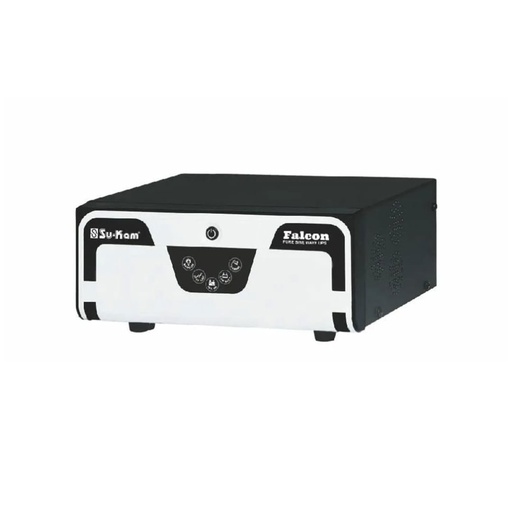
Su-Kam Falcon 1100VA
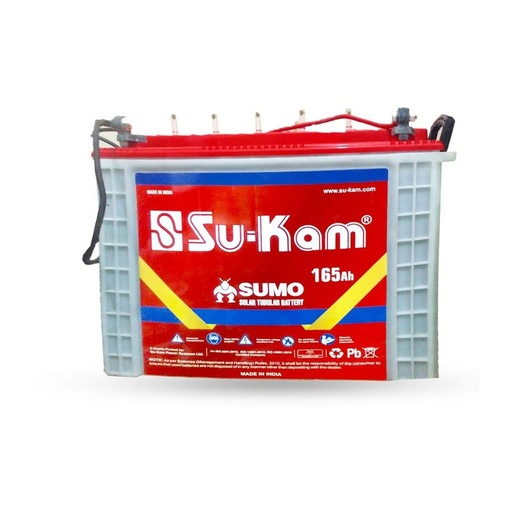
Su-Kam Sumo 165Ah
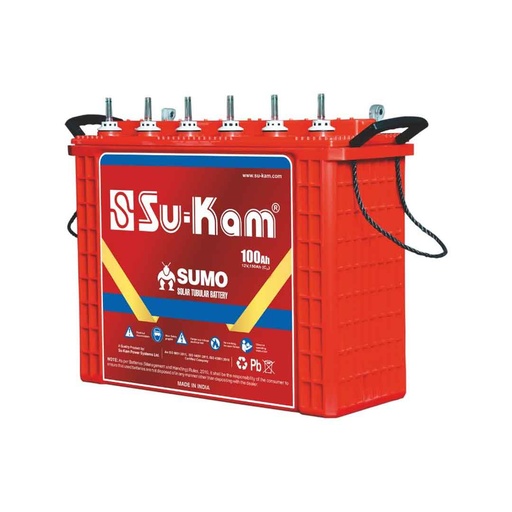
Su-Kam Sumo 100Ah
Frequently asked questions
How do I calculate inverter battery backup time?
Multiply the battery capacity in Ah by the battery voltage and by the efficiency, then divide by the load in watts. For a 150Ah, 12V battery at 80% efficiency and a 300 watt load: 150 x 12 x 0.8 / 300 = 4.8 hours.
What is the backup time of a 150Ah battery?
On a 290 watt load of two fans, three tube lights and a WiFi router, the plain formula gives about 6.2 hours, and Livguard and Genus make it 5.9 hours at 95% efficiency. Allowing for an older battery, expect about 5 hours from a healthy battery.
What is the backup time of a 200Ah battery?
At 80% efficiency a 200Ah, 12V battery gives about 19 hours at 100 watts, 6.4 hours at 300 watts and 3.8 hours at 500 watts.
How long will a 100Ah battery last?
At 80% efficiency a 100Ah, 12V battery gives about 9.6 hours at 100 watts and about 3.2 hours at 300 watts.
Why is my inverter backup less than calculated?
The usual reasons are an ageing battery, a battery that had not fully recharged, a heavy load that drains lead-acid batteries faster, or low water in a tubular battery.
Which battery do I need for 5 hours of backup?
Multiply your load in watts by 5 and divide by 9.6 for a 12V system at 80% efficiency. A 300 watt load needs about 156Ah, so choose a 150Ah or 165Ah battery.
Sources
- How to Calculate Inverter Battery Backup Time Easily (With Formula), Livguard, 28 October 2025
- How to Calculate Your UPS/Inverter Battery Back-up Time?, Genus
- How to Determine the Inverter Capacity for Your Home, Luminous, 3 September 2026
- Factors That Affect the Life of an Inverter Battery, Luminous, 3 September 2026
- Inverter Battery Water: Everything You Need to Know, Luminous, 2 September 2026
- Battery capacity and Peukert exponent (BMV-712 Smart manual), Victron Energy