National Advertising Policy 2083: What Influencers and Businesses in Nepal Must Disclose
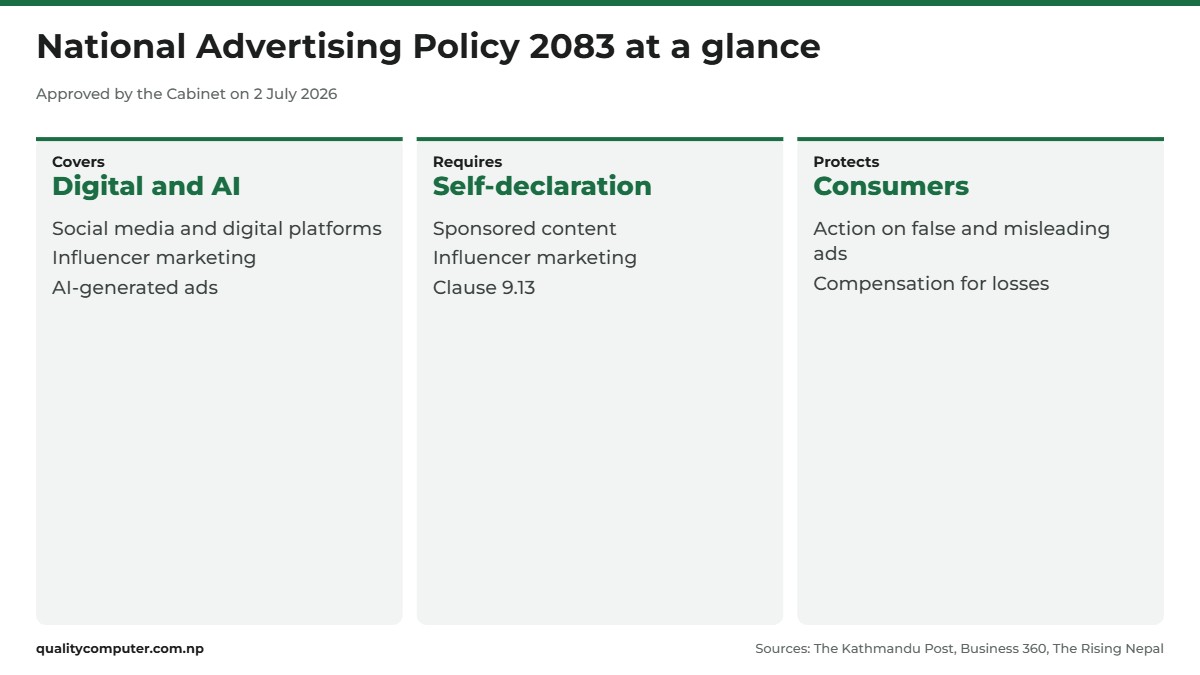
Short answer: The National Advertising Policy 2083 (2026) was approved by the Cabinet on 2 July 2026. For the first time it covers social media, influencer marketing and AI-made ads. Sponsored content and influencer marketing need a mandatory self-declaration, AI and deepfake ads are to be regulated, and consumers can claim compensation for false or misleading ads. It is a policy, not yet a law, so the detailed rules and penalties are still to come.
Shop at Quality Computer
Microphones, tripods and webcams View all →
What is the National Advertising Policy 2083?
It is a government policy for the whole advertising sector, described by former Advertising Board chair Laxman Humagain as Nepal's first comprehensive one. The Cabinet approved it on 2 July 2026 (Business 360, from RSS), and the Ministry of Information and Communication made it public the following week (The Rising Nepal). The full text, in Nepali, is on the Nepal Law Commission website.
This policy says plainly that advertising on social networking sites, digital platforms, through influencers and made with artificial intelligence now falls under regulation too. The Kathmandu Post reports that the policy aims to complete this framework within two years, with federal, provincial and local governments working together.
Its stated aims include protecting consumers, supporting Nepali products, creating jobs in advertising, and raising the sector's contribution to the economy within five years.
What influencers and creators must disclose
This is the part that touches almost everyone who posts for a brand. According to The Kathmandu Post, clause 9.13 of the policy says sponsored content and influencer marketing will require mandatory self-declaration. The Rising Nepal describes it as mandatory disclosure of promotional content on social media, digital platforms and by influencers.
In plain terms: if you were paid, given a free product, or otherwise rewarded to post about something, your audience has to be told. That applies to a TikTok review, an Instagram reel, a YouTube video or a Facebook post alike.
What the policy does not yet say is the exact format. It does not fix a wording, a hashtag or where the label must sit. Those details usually arrive in the regulations or code of conduct that follow a policy. Until they do, the safe practice is the one platforms already offer:
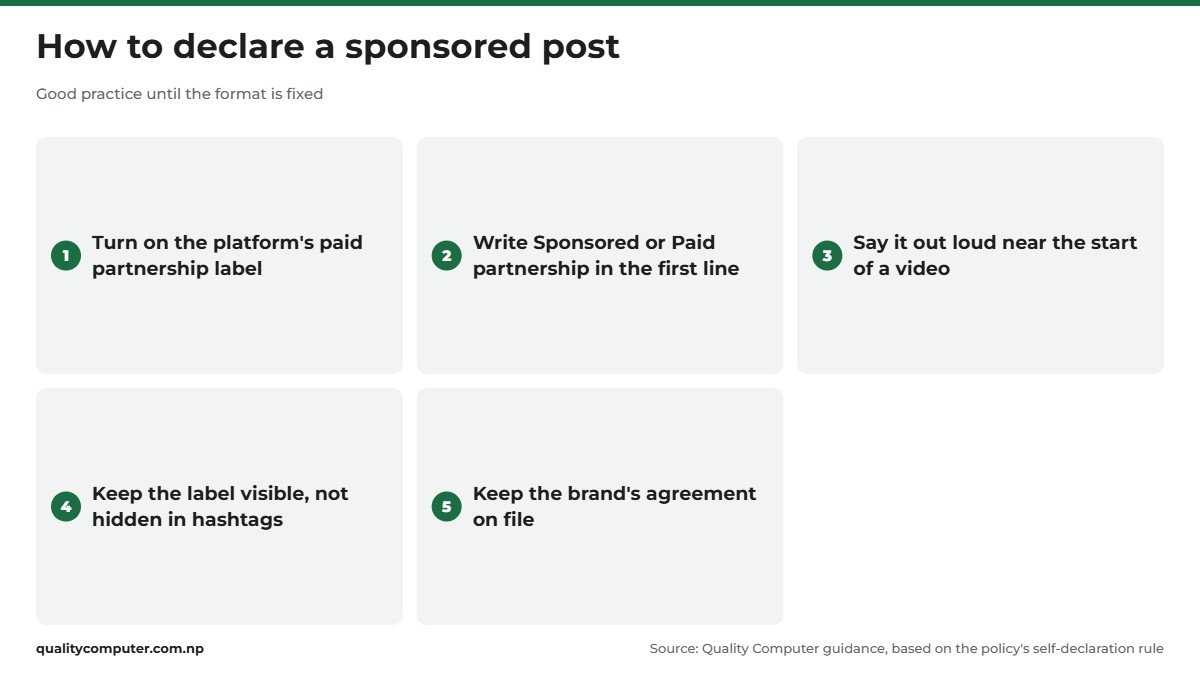
- switch on the platform's own "paid partnership" or "includes paid promotion" label;
- say it in the first lines of the caption, in the language your audience reads, for example "Sponsored" or "Paid partnership with [brand]";
- say it out loud near the start of a video;
- keep it visible. A label buried under "see more" or in a string of hashtags is not a declaration.
Starting a channel? Our vlogging kit guide covers the gear, and it is a good moment to build the disclosure habit in from the first video.
AI-generated and deepfake ads
The same clause covers artificial intelligence. Advertising created with AI, including deepfake content, will be regulated, The Kathmandu Post reports. Business 360 puts it as AI-generated deepfake ads being "legally regulated".
The policy does not ban AI in advertising. It encourages modern technology. The concern is ads that put words in a real person's mouth or show something that never happened. Ranjit Acharya, chief at Prisma Advertising, told The Kathmandu Post that regulating AI and deepfakes in advertising is necessary, and added that "monitoring and enforcement will be the most difficult and important part".
For a business using tools such as those in our free AI tools guide or ChatGPT to make posters and videos, the practical line is this:
- never use a real person's face or voice without their written permission;
- don't show results, crowds, reviews or endorsements that didn't happen;
- if an image or voice is AI-made and could be mistaken for real, say so.
If you see a fake ad using a celebrity's face to sell a scheme, report it. Our cyber scam helpline guide lists where.
What ads are not allowed
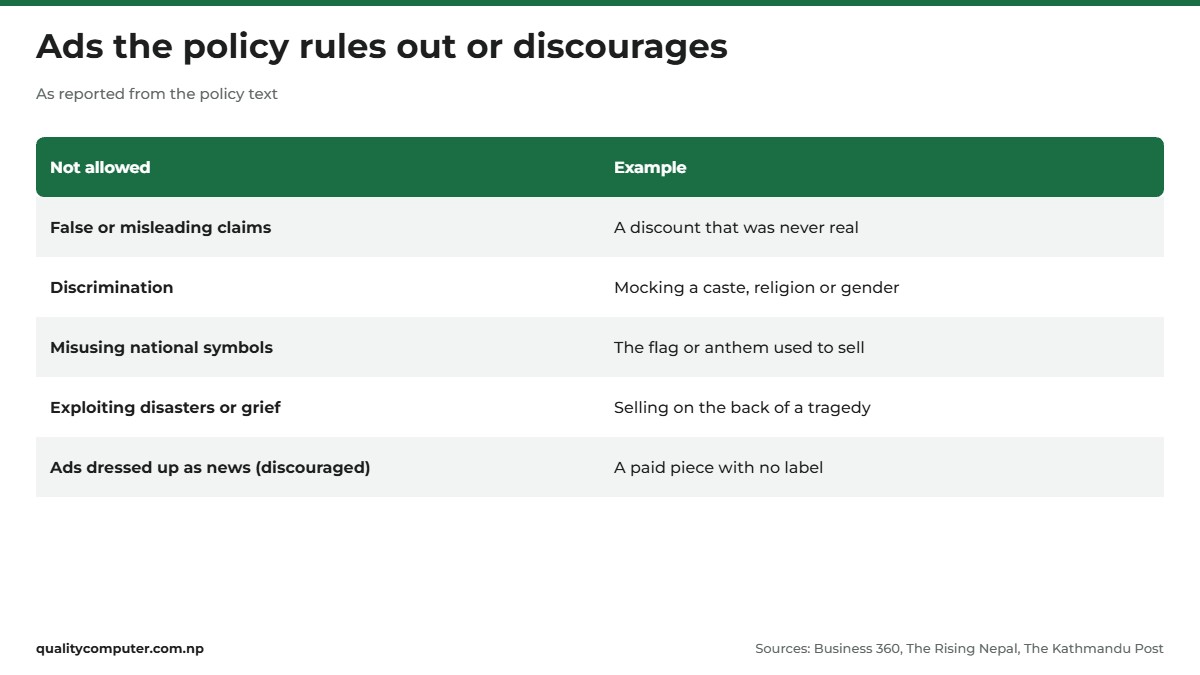
The policy sets out content that will not be permitted in any medium. As reported by Business 360 and The Rising Nepal, that includes:
- false or misleading ads that harm consumers;
- ads that discriminate by class, caste, religion, language, culture, community or gender;
- ads that undermine Nepal's sovereignty or misuse the national flag, national anthem or national figures;
- using disasters, grief or other sensitive situations for commercial gain;
- obscene or violent content, and content harmful to children.
It also says that dressing up ads as news, and news as ads, will be discouraged (clause 9.8, per The Kathmandu Post).
Two points matter for shoppers. First, consumers who suffer a loss from a false or misleading ad are to be entitled to compensation. Second, Ratopati reports that ads with factually wrong or misleading claims that affect public health are to be "completely controlled". So "cures", "guaranteed results" and fake discounts are the riskiest things a seller can post.
Is it in force yet?
The policy is approved and public, but a policy is a statement of what the government intends to do. New fines and complaint procedures for things like undeclared sponsored posts need laws and regulations.
The Rising Nepal reports that laws, regulations, codes of conduct and procedures are to be amended to carry it out. Former Advertising Board chair Laxman Humagain told The Kathmandu Post that the policy alone is not sufficient and strong legislation will be needed. In October the Advertising Board (its official English name is the Advertisement Board) said the policy was in the implementation phase and that it plans to amend the Advertisement (Regulation) Act, 2076 and related rules to match it (Radio Nepal).
What the policy sets up:
- the Advertising Board is to be made more autonomous and better resourced;
- a National Advertising Council is to be formed for monitoring, regulation and self-regulation;
- provincial monitoring committees and local advertising committees may be set up;
- an advertising fund, an information bank and a system for classifying media;
- the ministry is to review the policy every year and revise it fully every five years.
There are measures for the wider market as well. The Rising Nepal reports that advertising spending is to be linked to the tax system, that ads for Nepali goods and services are to get special incentives, and that companies selling foreign products will have to spend a set share on consumer awareness. Ratopati adds that foreign advertisements will come under the "clean feed" system, and that standards for hoarding boards and ads on public transport will be set with local governments.
No penalty amounts for undeclared posts appear in any of the reports we read. Treat anyone quoting a specific fine for an undeclared post as guessing, at least until the regulations appear.
What creators and businesses should do now
You don't need to wait for the regulations to do the right thing, and doing it early costs nothing.
If you are a creator:
- label every paid or gifted post, every time;
- keep the agreement or message where the brand asked you to post, in case you are ever asked;
- don't repeat a claim about a product that you can't check yourself;
- when you edit in an app such as CapCut, put the "Sponsored" line on screen in the first seconds.
If you are a business:
- ask every creator you pay to declare the partnership, and put it in the agreement;
- check the claims in your own ads: prices, discounts, warranty and "authorised" status should all be true on the day;
- keep proof for any number you advertise;
- don't use AI to invent testimonials or to copy a person's face or voice.
Good sound makes a declaration easy to hear. If your videos are hard to follow, a clip-on microphone such as those in our Boya mic guide helps more than a new camera.
Quick verdict
- The National Advertising Policy 2083 was approved on 2 July 2026 and covers social media, influencers and AI ads.
- Sponsored content and influencer marketing need a mandatory self-declaration (clause 9.13).
- AI-made and deepfake ads are to be regulated; never use a real face or voice without permission.
- Consumers are to be entitled to compensation for losses from false or misleading ads.
- Detailed rules and penalties are not out yet, so label paid posts clearly now.
Gear for creators in our store
Microphones, tripods, webcams and memory cards for making content, from the Quality Computer store.
| Product | What it is | Our price |
|---|---|---|
| BOYA BY-M1 clip-on mic | Wired lavalier microphone | Rs 1,650 |
| Fantech Leviosa Air WMV11C wireless mic (USB-C) | Wireless lavalier microphone for USB-C phones | Rs 3,150 |
| BOYA BY-M2 Lightning mic for iPhone | Lavalier microphone for iPhones with a Lightning port | Rs 4,490 |
| HiFuture WM100 wireless handheld mics | Wireless microphone | Rs 5,440 |
| Fantech SS170 selfie stick tripod | Selfie stick tripod with a remote | Rs 1,260 |
| UGREEN 175cm aluminium tripod | Aluminium travel tripod with a phone holder | Rs 6,430 |
| ViewSonic C910 2K webcam | 2K webcam | Rs 4,500 |
| Logitech BRIO 100 webcam | Full HD webcam | Rs 7,199 |
| Lexar 633x 128GB microSDXC V30 | 128GB microSD card for video | Rs 5,500 |
Prices checked on 22 November 2026 on our website.
In our store
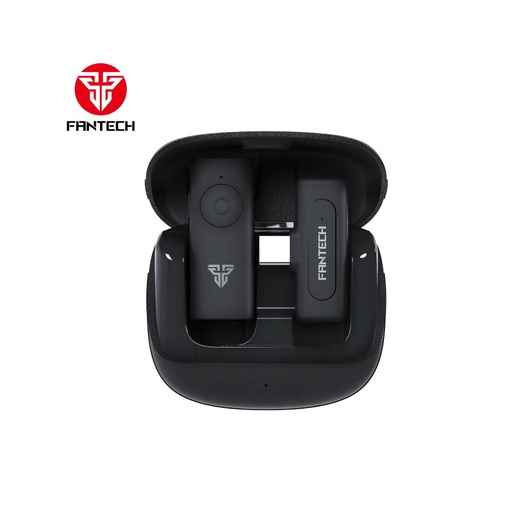
Fantech LEVIOSA AIR WMV11C
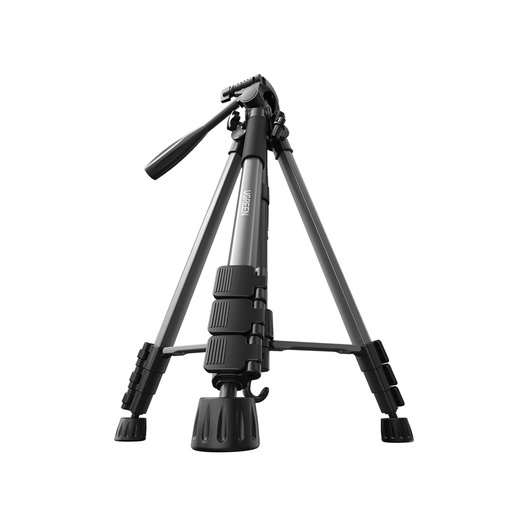
UGREEN travel tripod
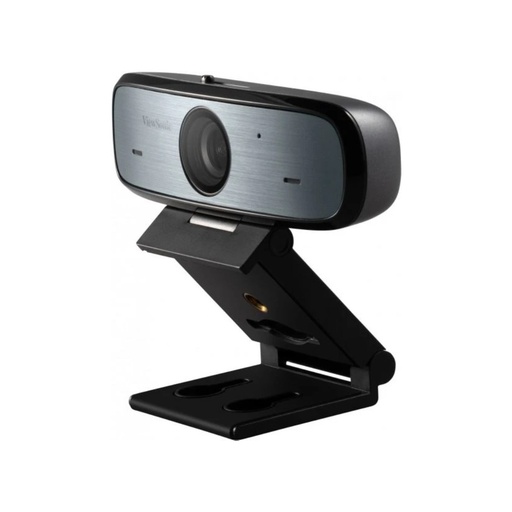
ViewSonic C910 webcam
Frequently asked questions
What is the National Advertising Policy 2083?
It is a national policy for the advertising sector, approved by the Cabinet on 2 July 2026 and described as Nepal's first comprehensive one. It brings social media, digital platforms, influencer marketing and AI-generated advertising under regulation.
Do influencers in Nepal have to disclose sponsored posts?
Yes. The policy says sponsored content and influencer marketing will require mandatory self-declaration. The exact wording and format have not been published yet.
Are AI-generated ads banned in Nepal?
No. The policy encourages modern technology but says advertising created with AI, including deepfake content, will be regulated.
What is the penalty for not disclosing a paid promotion in Nepal?
No penalty amounts have been published. The policy needs laws and regulations to set fines and procedures, and those were still to come at the time of writing.
Can I get compensation for a misleading ad in Nepal?
The policy says consumers who suffer a loss from false or misleading advertising are to be entitled to compensation. The procedure will be set by the laws that follow.
Who regulates advertising in Nepal?
The Ministry of Information and Communication and the Advertising Board are the main regulators. The policy also calls for a National Advertising Council and provincial and local committees.
Sources
- Nepal brings social media, AI advertising under new national policy, The Kathmandu Post, 5 July 2026
- National Advertisement Policy, 2083 approved; social media and AI advertising brought under regulation, Business 360 (RSS), 2 July 2026
- Govt approves National Advertising Policy, The Rising Nepal, 4 July 2026
- Government Approves National Advertisement Policy 2083 to Regulate Digital Media, Ratopati, 15 July 2026
- Govt unveils National Advertisement Policy, The Rising Nepal, 11 July 2026
- National Advertising Policy, 2083 (full text, in Nepali), Nepal Law Commission, 6 Ashoj 2083
- Advertisement Board puts digital advertisement regulation in priority, Radio Nepal, 15 October 2026