Automatic School Bell System: How to Choose a Timer, Bells and Speakers
Short answer: An automatic school bell is a programmable timer (a controller) that rings your bells, or plays tones through speakers, at the times you set, so nobody has to ring the period bell by hand. Choose the sound first: a 230 V gong bell for loud, simple signals, a buzzer for small indoor spaces, or a speaker system if you also want announcements. Then check the controller for enough schedules and ring times, a manual ring button, a clock battery for power cuts, and an output rating that covers all your bells.
Shop at Quality Computer
School bell timers and gong bells View all →
What an automatic school bell system is
It does the job of the person who rings the bell by hand. A controller, also called a bell timer or bell controller, holds your timetable and switches the bells on at every period change, break and home time. It has four parts:
- The controller. A box with a clock, a memory for ring times and an output that switches the bells on. Zamel's EW-01 school bell set, for example, lists a relay output, a real-time clock and a built-in calendar.
- The sound. One or more electric bells, buzzers, or a speaker system that plays tones and announcements.
- The wiring. Cable from the controller to every bell or speaker on the campus.
- Power. Mains power for the controller and bells, and a backup if your area has power cuts.
Some controllers ask for each ring time. Others work it out for you: Zamel says its SDM-10 controller is programmed by choosing the lesson length, the break length and the start time.
Automating the office as well? See our guide to e-attendance devices.
Gong bell, buzzer or speakers: choosing the sound
Decide what you want people to hear before you choose a controller. There are three main options.
Electric bell
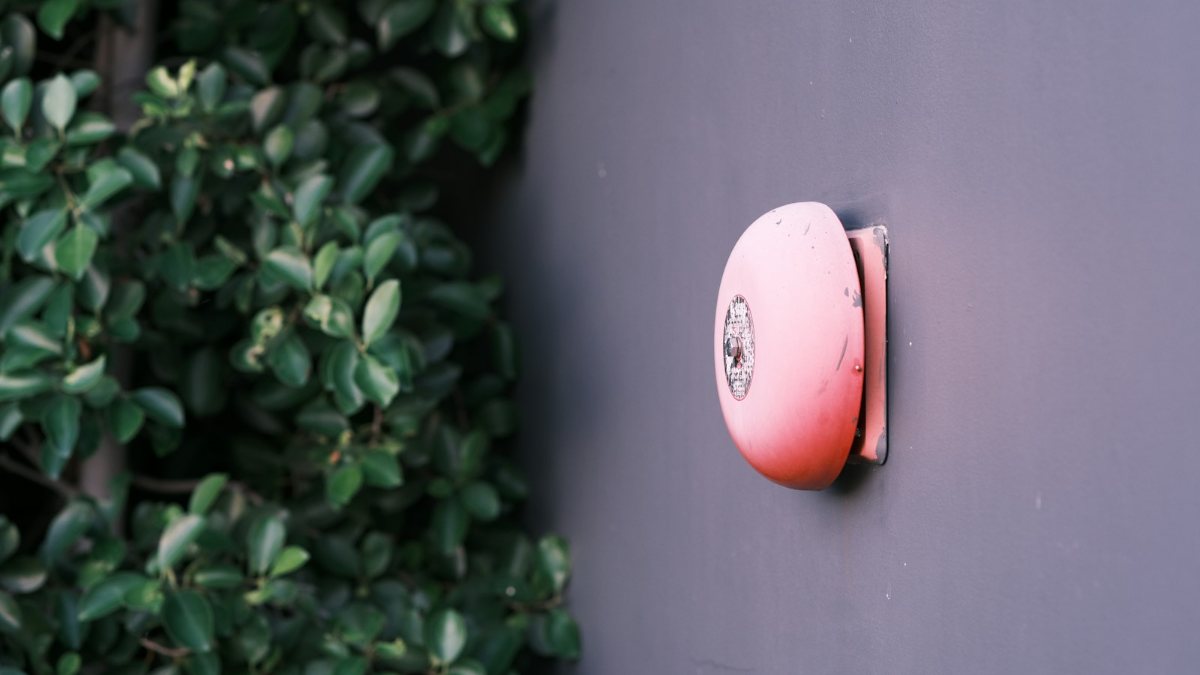
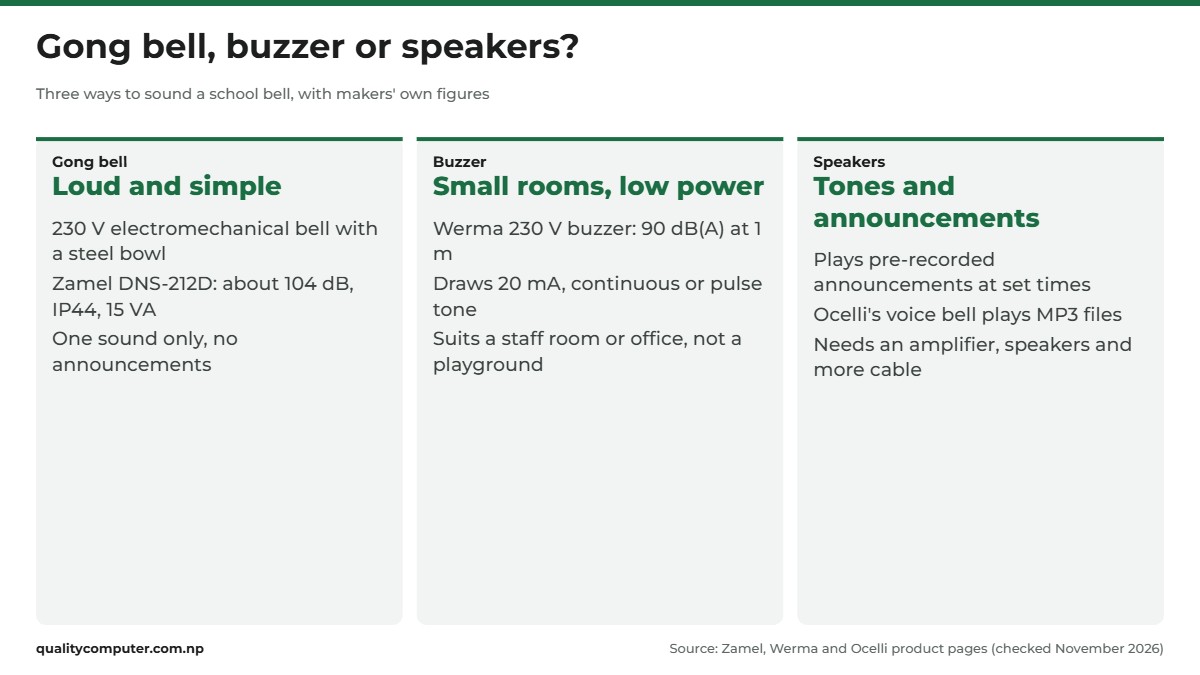
The usual electric bell for school is a gong bell: an electromechanical bell with a metal bowl, wired to 230 V mains. Zamel's DNS-212D school bell is one example, with a 230 mm steel bowl, a loudness of about 104 dB, an IP44 rating and a power consumption of 15 VA. It's loud and simple, and one timer can drive several. But it makes one sound only, and it can't give an announcement.
Buzzer
A buzzer is smaller and draws very little power. Werma rates one of its 230 V buzzers at 90 dB(A) at 1 m, drawing 20 mA. It suits a staff room, an office or a small block, but not a playground. Makers don't all measure loudness the same way (Werma states the distance, Zamel doesn't), so compare by listening, not by the number on the box.
Speaker (broadcast) system
Here the timer plays a sound file through speakers instead of switching a bell. Ocelli says its Smart Voice Bell plays "pre-recorded voice announcement at a pre-programmed time" from MP3 files, and it lists a wireless microphone set. A broadcast speaker system can play a softer tone in classrooms and carry notices from the office. The trade-off is more equipment: an amplifier, a speaker in each area and more cable.
Check which kinds of bell a timer can drive. Ocelli says its Industrial Bell Timer, for example, works with 9-inch or 12-inch gong bells, hooters or industrial sirens.
How to choose a school bell timer
The controller is the brain of an automatic school bell, so check these points before you buy. Shops sell it under many names: period bell, digital school bell, smart school bell. Ocelli, for one, calls its phone-programmed timer a "SMART BELL" timer.
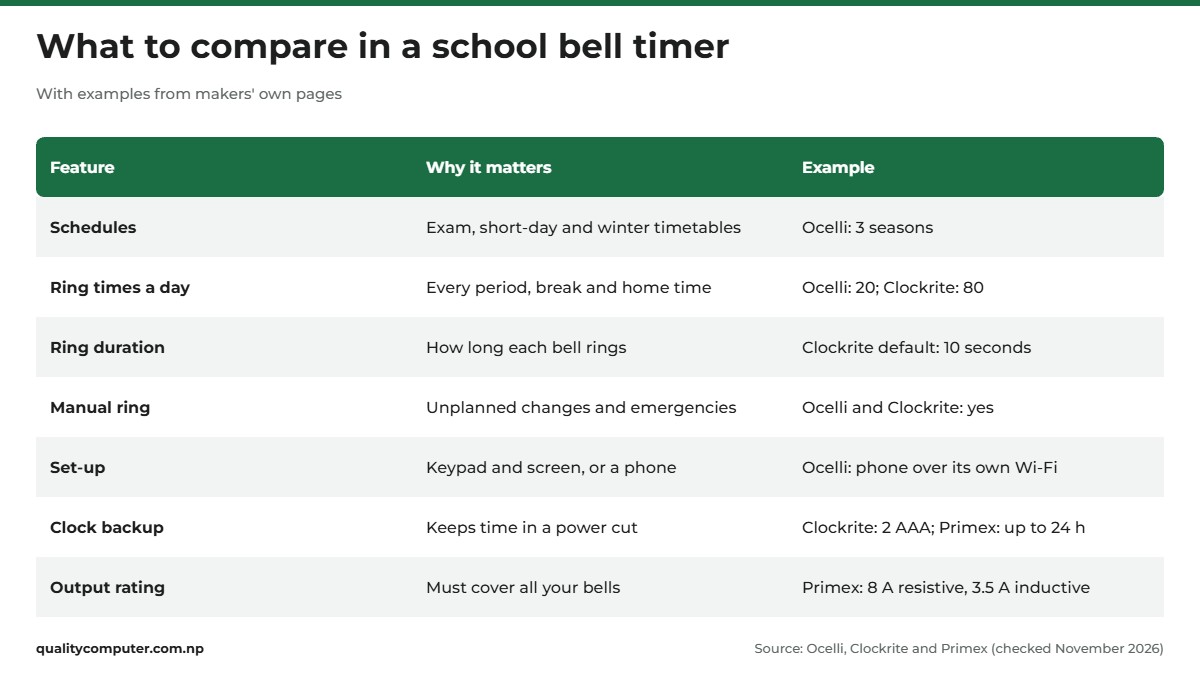
- Schedules. You may need more than one timetable: normal days, exam days, short days and winter timings. Ocelli's Industrial Bell Timer supports 3 seasons "(Exam, Half Day, Summer/Winter)" and unlimited holidays. A timer with only one schedule means changing the ring times by hand each time the timetable changes.
- Ring times per day. Count every period change, break, assembly and home time, then add a few. Ocelli's Industrial Bell Timer takes up to 20 rings a day, and Clockrite's automatic bell timer up to 80.
- Ring duration. Clockrite's default is 10 seconds, and you can change it.
- Days and holidays. You should be able to switch each ring on or off for each weekday, so the bell stays quiet on Saturdays and holidays.
- Manual ring. A button for an unplanned change or an emergency. Ocelli's and Clockrite's timers both have one.
- Keypad or phone. Some timers have buttons and a screen. Others are set up from a phone: Ocelli says its timers can be configured "from any smartphone over its WIFI network". If a timer mentions Bluetooth, ask what it's for: setting it up from a phone, or playing audio.
- Clock backup and output rating. Both get their own sections below.
How many bells or speakers, and where to put them
Walk the campus during a noisy break and note every place that must hear the bell: each block and floor, the playground, the hall, the staff room and the office. Then test before you buy them all. Fit one bell, close the doors of the farthest classroom and listen. Add bells where it's faint.
Sound fades quickly outdoors. Boxlight, which makes school PA systems, works on 6 dB of loss per doubling of distance outside, so a bell on the main building may not reach the far end of a large ground.
Speakers
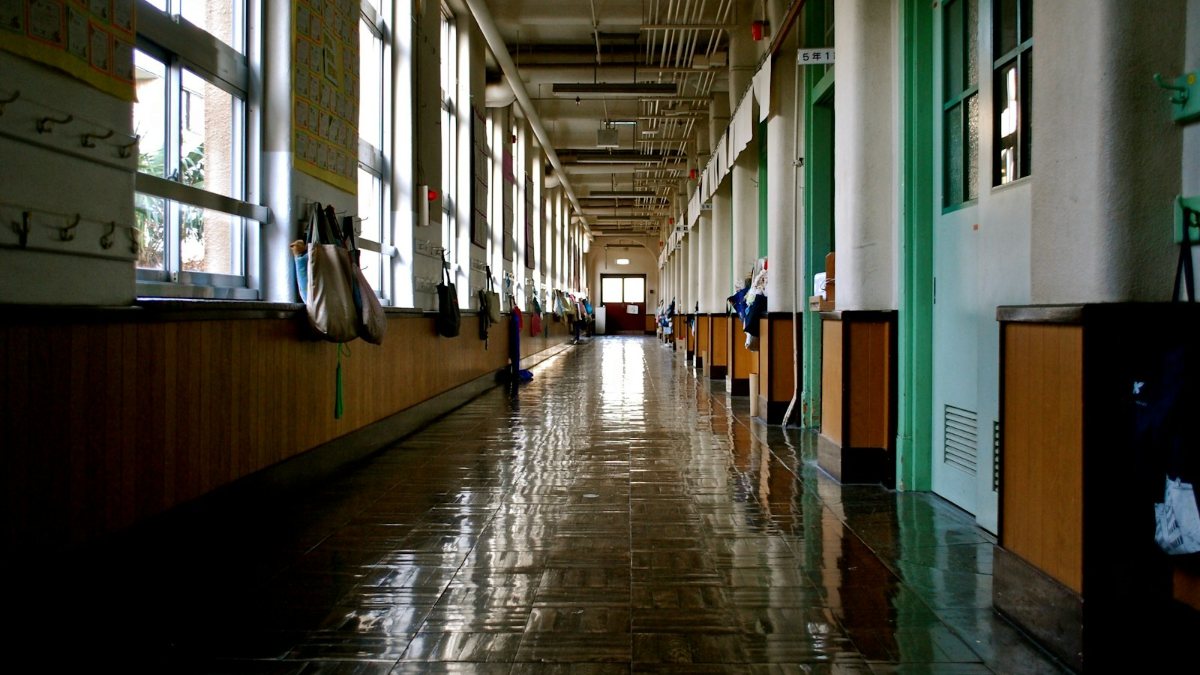
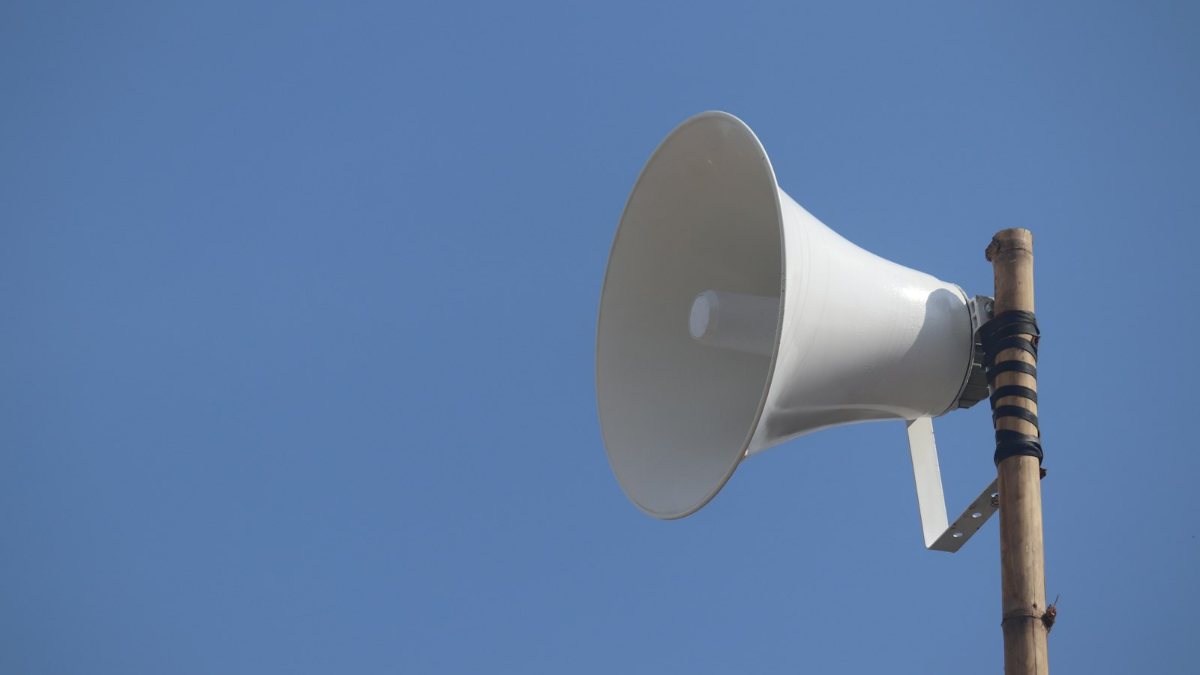
Boxlight says industry practice is to place corridor speakers "approximately 2 times the ceiling height apart". TOA, another PA maker, says to spread ceiling speakers evenly, and that mounting them higher gives a greater range. For large areas, TOA says high-impedance wiring is preferable, as it cuts line losses and allows long cables. Ask the seller how many speakers one unit can drive, and over what length of cable.
Halls are harder. Boxlight notes that sound in gyms echoes for 3 to 7 seconds, against a 1 to 1.5 second target for clear speech, so announcements are hard to follow. A bell or tone only has to be heard. Where balls fly, Zamel sells a steel wire guard to protect its bell from "a ball stroke".
One controller, several bells
Every bell on the line is switched through the controller's output. Add up the current or VA of all the bells (Zamel's DNS-212D draws 0.07 A, or 15 VA) and compare the total with the controller's rating. Read that rating carefully. Primex rates its controller's relays at 8 A for resistive loads but only 3.5 A for inductive loads, and Omron, a relay maker, advises leaving "sufficient leeway" with inductive loads. A rating marked AC1, like the 16 A on Zamel's SDM-10, is for "non-inductive or slightly inductive loads" (celduc). Ask which figure applies to bells. If you need more, an electrician can add separate relays, as Zamel's EW-01 set does.
Wiring and safety
Most school bells and controllers run on 230 V mains, so the wiring is a job for a qualified electrician, not the school handyman. Primex's installation guide is clear: wiring "must be performed by qualified personnel", all power must be turned off first, and the work must follow local and national electrical codes.
- Give it its own switch. A separate switch or MCB lets you turn the bells off without cutting power to classrooms. Zamel's EW-01 set includes a switch disconnector for this. In Kantipur, the head of the Electricity Authority's Gulmi distribution centre advised using wires and MCBs of the right capacity, and not fitting a thicker fuse after one blows.
- Keep the controller indoors. Primex says its bell controller "must be installed indoors". Put it in the office, out of students' reach.
- Weatherproof outdoor bells. Check the IP rating. In the IEC's IP code, the second digit is for water: 4 means protected against splashing water from any direction, and 5 against water jets (Hammond, on the IEC IP code). Zamel's DNS-212D is IP44, but Zamel doesn't say it's for outdoor use. For an open verandah or a pole, ask the seller for the bell's IP rating and mount it under cover.
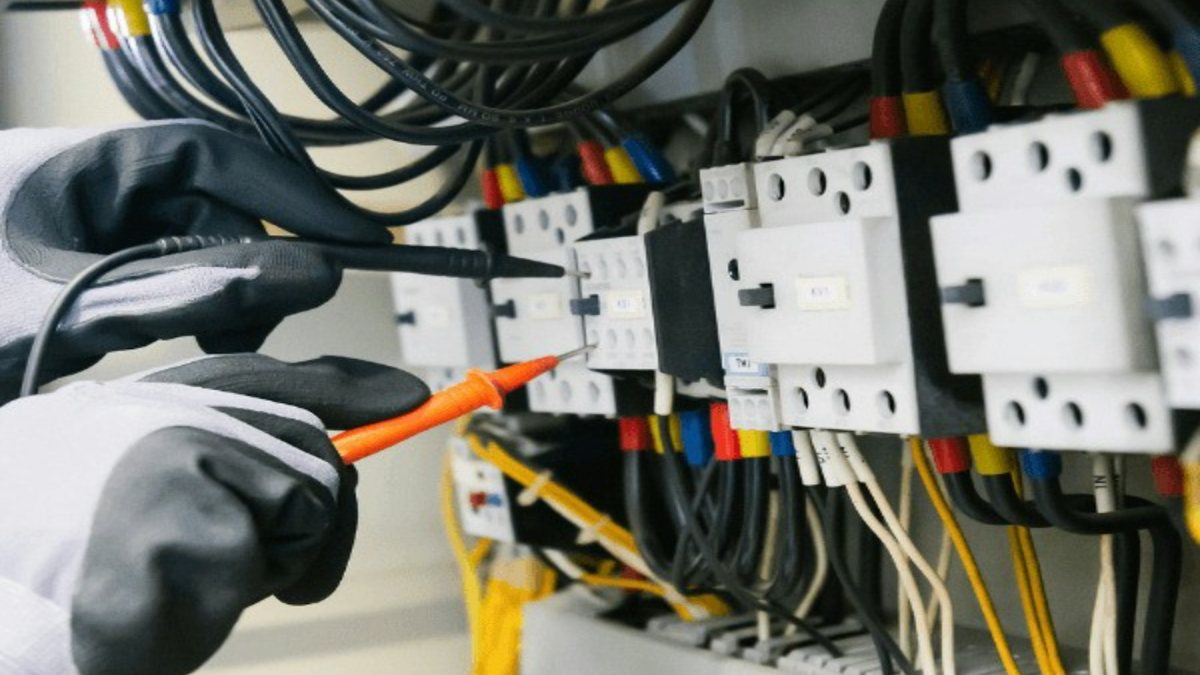
Run cables in conduit or trunking where students can reach them, and label the bell circuit at the distribution board.
Power cuts: keeping time, and keeping the bells ringing
A power cut causes two separate problems: the timer can lose its time, and the bells can't ring.
Keeping time. Some controllers keep their clock and settings on a small battery. Zamel says its SDM-10's battery keeps all settings in a power failure, Clockrite's timer takes two AAA batteries as backup, and Primex estimates up to 24 hours on two AA lithium batteries. If the maker doesn't say, ask the seller: does it have a clock battery, how long does it last, and does the clock need resetting after a cut?
Keeping the bells ringing. A clock battery keeps the timetable, but a 230 V bell still needs mains power to ring. To keep bells ringing through a cut, put the controller and bell circuit on a UPS or your school's inverter.
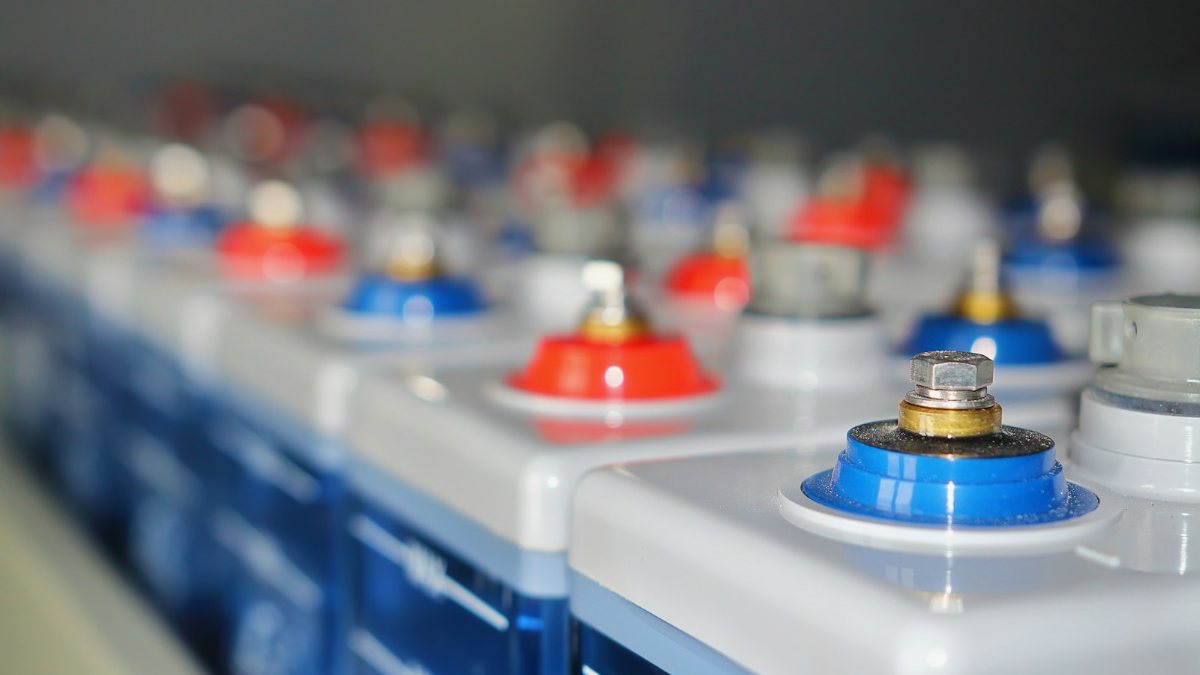
Size the backup to the load. Schneider Electric's UPS guide says a UPS "should have a VA rating higher than your total device watt load", and that runtime depends on battery capacity and the load. Bells draw little (Zamel's big bell uses 15 VA), but count any amplifier and speakers too. A bell's coil also draws a short surge each time it switches on (Omron's relay guide puts a solenoid's switch-on current at several times its normal current), so ask whether the UPS or inverter can start all the bells at once.
After a long cut, check the timer's clock, and check it on a new timer too. Ocelli says that on its voice bell, the "date and time may not be correct when the device is powered up for the first time", until it is set up.
Setting up the bell timetable
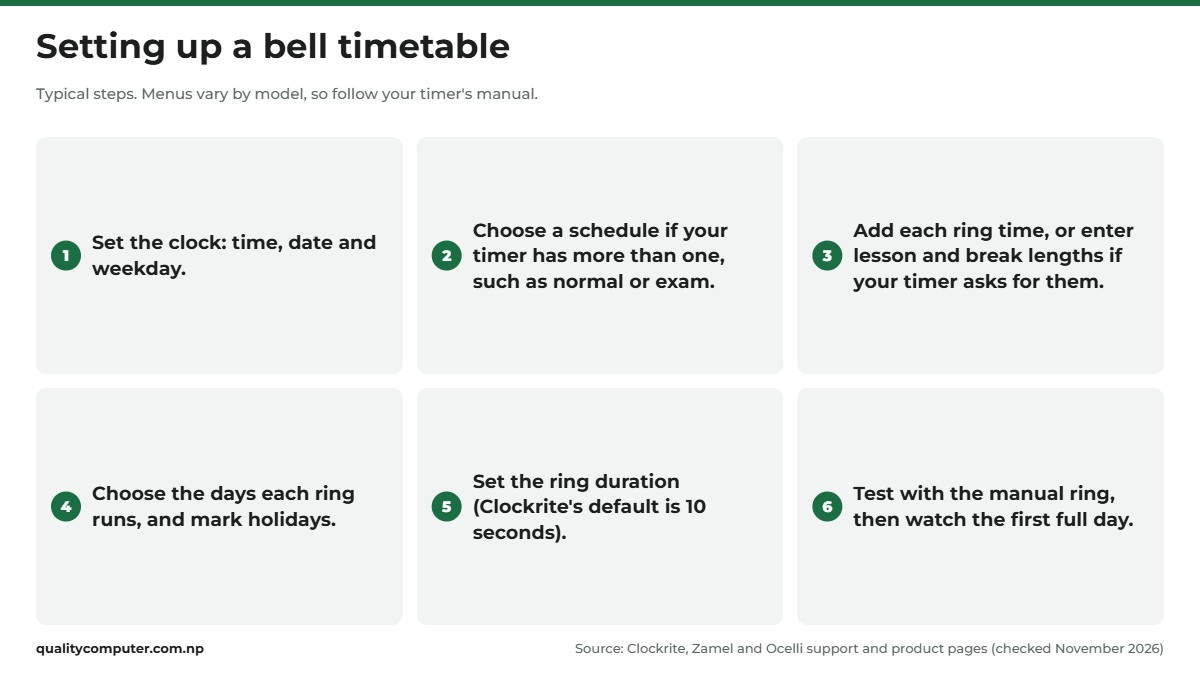
These are typical steps, broadly in the order Clockrite's guide uses. Menus vary, and we couldn't find a published manual for the HASB-102 or the SB10XX, so follow the printed manual that comes with yours.
- Write the timetable on paper. List every ring time for a normal day, then for exam and short days.
- Set the clock. Enter the time, date and weekday. On Clockrite's timer, you press MODE once and "TC" appears.
- Choose a schedule if your timer has more than one, such as normal or exam.
- Add each ring time. On Clockrite's timer, press MODE twice for "PROG", pick a slot and set the hour and minute. On Zamel's SDM-10, you enter lesson and break lengths instead.
- Choose the days each ring runs and mark holidays.
- Set the ring duration, such as Clockrite's default of 10 seconds.
- Test. Use the manual ring, then watch the first full day.
Phone-set timers work differently. For its Industrial Bell Timer, Ocelli says you need "no external WiFi": you open 192.168.4.1 in a browser on "your phone, PC, or laptop", with no app needed. If the office computer is old, see our guide to PCs for schools and offices.
Give a printed copy of the timetable and any password to two members of staff.
Bell timers, gong bells and speakers to compare
We describe these models only from their names and their makers' own pages, so ask the questions above before you buy.
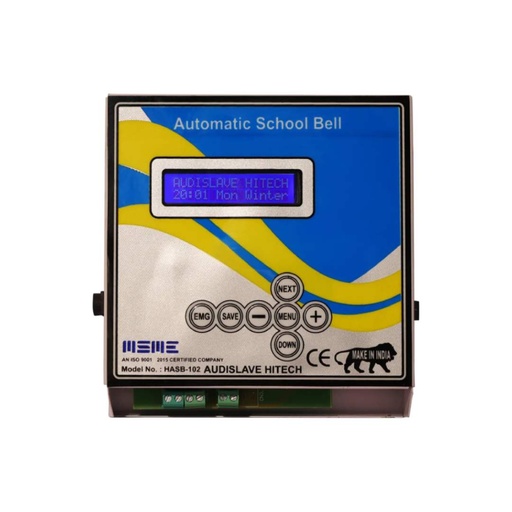
- HASB-102 AudiSlave Hitech timer with Bluetooth. By its name, a bell timer with Bluetooth. Audislave Hitech, a Delhi company, says it has made school bell systems since 2004. Its catalogue lists an HASB-101 with a "Bluetooth facility" but doesn't explain it, and doesn't list the HASB-102. Ask what the Bluetooth is for, how many schedules it holds and whether it has a clock battery.
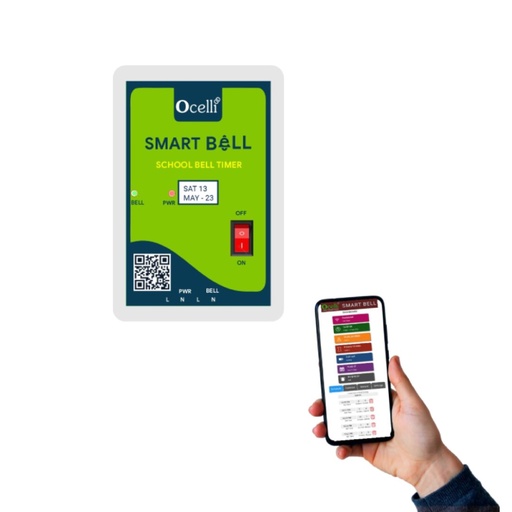
- SB10XX-1SD basic smart timer controller (one schedule). Made by Ocelli, a Bangalore company that says its timers are set up from a phone over their own Wi-Fi. Its website doesn't list the SB10XX model. Its name says one schedule, which suits a school with one timetable most of the year, so ask how many it holds. Check its ring limit and clock backup.
- School Bell Timer. No maker is named, so ask for the manual and check it against the list in the timer section.
- AudiSlave Hitech School Audio Broadcast Speaker. A speaker for an AudiSlave Hitech broadcast set-up. The maker's catalogue lists school broadcast systems, including a "single wire solution", two-way broadcast and a talk-back unit. Ask which control unit it works with and what's in the box.
- 9-inch gong bell (220/230 V). A mains bell with a 9-inch gong, a size Ocelli lists for its Industrial Bell Timer. Ask for its IP rating if it's going outdoors.
Quick verdict
- Choose the sound first: a gong bell for loud signals, a buzzer for small rooms, speakers for announcements.
- Check the timer for enough schedules and ring times, adjustable ring duration and a manual ring button.
- Add up your bells' load and compare it with the controller's rating for inductive loads, if given.
- A clock battery keeps the timetable in a power cut, but a 230 V bell needs a UPS or inverter to ring.
- Have a qualified electrician wire it on its own switch or MCB, with outdoor bells under cover.
- Test the timetable on day one and check the clock after long power cuts.
School bell timers, gong bells and speakers in our store
If you're setting up an automatic bell, you need a timer and the bells or speakers it will drive. Check each one against the questions in this guide.
| Product | What it is | Our price |
|---|---|---|
| AudiSlave Hitech HASB-102 automatic school bell (timer with Bluetooth) | Automatic bell timer with Bluetooth audio | Rs 10,500 |
| SB10XX-1SD smart school bell timer controller | Smart bell timer controller, one schedule | Rs 8,000 |
| School bell timer | Programmable school bell timer | Rs 9,500 |
| Gong bell 9" (220/230V) | 9-inch electric gong bell, 220/230V | Rs 3,800 |
| AudiSlave Hitech school broadcast speaker | Broadcast speaker for announcements and bell tones | Rs 2,650 |
Prices checked on 15 November 2026 on our website.
In our store
AudiSlave HASB-102
SB10XX-1SD timer
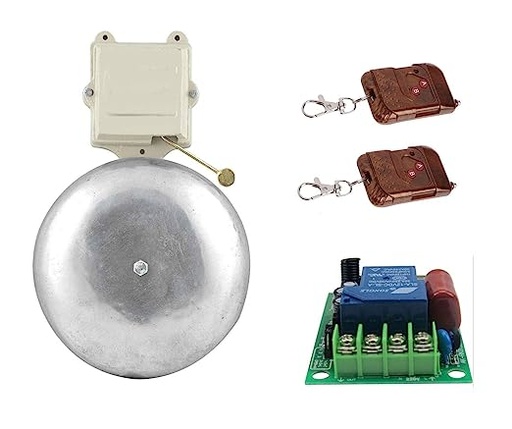
Gong bell 9-inch
Frequently asked questions
What is an automatic school bell system?
It is a programmable timer that rings electric bells, or plays tones and announcements through speakers, at the times you set. It has a controller, the bells or speakers, the wiring between them and a power supply.
How does a school bell timer work?
It keeps a clock and a list of ring times. At each set time it switches its output on for the ring duration you choose, which sounds the bells wired to it. Many timers also let you choose the days each ring runs and mark holidays.
Is a gong bell or a speaker system better for a school?
It depends on what you need. A 230 V gong bell is loud and simple. A speaker system can play softer tones and announcements, but needs an amplifier, more speakers and more cable.
How many bells can one bell controller run?
It depends on the controller's output rating and the power each bell draws. Add up the current or VA of all the bells and keep the total well under the controller's rating for inductive loads, if the maker gives one. If you need more, an electrician can add separate relays.
Does a smart school bell work during a power cut?
Some timers keep their clock and settings on a small battery, but a 230 V bell needs mains power to ring. To keep the bells ringing in a power cut, put the controller and bell circuit on a UPS or inverter rated above the total load.
How do I set a period bell timetable?
Set the timer's clock, date and weekday first. Then add each ring time, choose the days it runs, mark holidays and set the ring duration. Test it with the manual ring button and watch the first full day.
Can a digital school bell play announcements?
Some can. Voice bells and broadcast systems play pre-recorded announcements or tones through speakers at set times. A timer that only switches a gong bell cannot.
Sources
- School-alarm 230V bell big, type DNS-212D, Zamel
- School-alarm bell protection, type ODS-256D, Zamel
- School bell controller, type SDM-10/U, Zamel
- School bell controller 230V AC, type EW-01, Zamel
- Electronic buzzer EM, continuous/pulse, 230 V AC, Werma
- School bell timer controller, Ocelli Systems
- Automatic school bell (Industrial Bell Timer), Ocelli Systems
- Ocelli Systems Private Limited: company profile, Ocelli Systems on IndiaMART
- Automatic school bell, Audislave Hitech on IndiaMART
- Audislave Hitech Technologies: products, Audislave Hitech on IndiaMART
- Bell Controller specifications, Primex Support
- Install Bell Controller, Primex Support
- Automatic Bell Timer, Clockrite Support
- IEC 60947 series: utilization categories, celduc relais
- Relays: precautions for correct use, Omron Industrial Automation
- PA coverage (K-12 school planning tools), Boxlight
- Electroacoustic systems, TOA Electronics Europe
- IEC enclosure ratings (IP code), Hammond Manufacturing
- How can a house fire be prevented due to an electrical short circuit?, Kantipur, 4 December 2025
- UPS buying guide for selecting a battery backup system, Schneider Electric (APC)